
 English
 Indonesian
 简体字
简体字
 العربية
 Español
 Français
 Português
 日本語
日本語
 한국어
한국어
 Tiếng Việt
Sign In to Continue
To view and access the document, you are required to sign in to your account first.
Don't have an account? Sign Up Here
Home Top Industrial Uses of Soda Ash in 2026
Applications and Buyers | 13 May 2026
Top Industrial Uses of Soda Ash in 2026
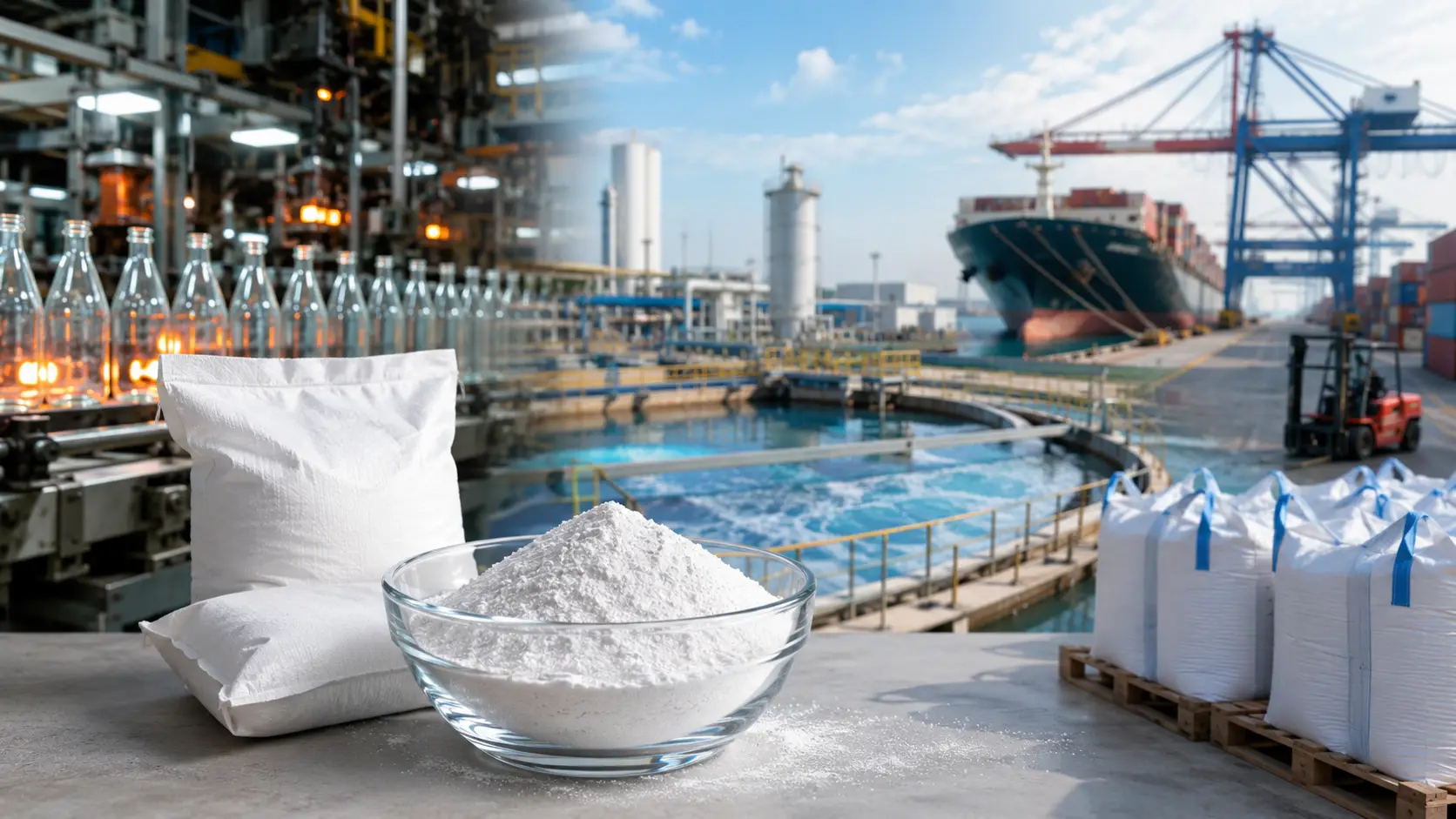
Table of Content
-
Introduction
-
Global Soda Ash Market Outlook for 2026
-
Core Industrial Applications of Soda Ash
-
Product Types and Specifications: Dense vs Light Soda Ash
-
Supply, Sourcing, and Buyer Considerations on sodaash.net
-
Conclusion
Introduction
The global market for soda ash (sodium carbonate, Na₂CO₃) is entering a pivotal phase as we approach 2026. Used across glass, detergents, chemicals, metallurgy, water treatment, and more, this versatile inorganic chemical is a backbone material for both mature and emerging industries. As decarbonization, circular economy models, and shifting consumer preferences reshape manufacturing, understanding the evolving industrial applications of soda ash is critical for producers, buyers, and downstream users alike.
By 2026, global soda ash demand is projected to exceed 70 million metric tons per year, driven by robust construction activity, growth in packaging and flat glass for solar and automotive applications, and steady consumption in household and industrial cleaning products. At the same time, capacity expansions in regions such as China, the United States, Turkey, and parts of Africa are rebalancing trade flows and pricing dynamics. Platforms like sodaash.net and global distributors such as Tradeasia are increasingly central to connecting buyers with reliable suppliers and up-to-date market information.
This article provides a structured, in-depth overview of the top industrial applications of soda ash expected to shape the market landscape in 2026. It also examines product grades such as dense soda ash and light soda ash, key technical considerations for end users, and practical sourcing insights for procurement teams. The goal is to support strategic planning, supplier evaluation, and application development across the global chemicals and materials value chain.
Global Soda Ash Market Outlook for 2026
The global soda ash market has historically grown at an average rate of around 2–3% per annum, with cyclical fluctuations tied to construction and automotive demand. Looking ahead to 2026, most industry forecasts anticipate a market size in the range of USD 25–30 billion, underpinned by three major demand pillars: glass manufacturing (typically 45–55% of total consumption), detergents and cleaning products (10–15%), and chemical synthesis (10–15%). Emerging uses in environmental applications and lithium battery supply chains are expected to add incremental growth.
Regionally, Asia-Pacific remains the dominant demand center, led by China, India, and Southeast Asia. China alone accounts for more than one-third of global soda ash consumption, largely due to its massive flat glass and container glass industries. By 2026, India’s soda ash demand is projected to grow at a faster rate than the global average, driven by urbanization, infrastructure projects, and rising detergent consumption. Meanwhile, North America and Europe maintain stable, technology-intensive markets, with a growing emphasis on energy-efficient glass and eco-labeled cleaning products.
On the supply side, natural soda ash derived from trona ore in the United States, Turkey, and parts of Africa is gaining relative importance, as producers and buyers seek lower carbon footprints and cost stability. Synthetic soda ash production (via the Solvay or Hou process) remains significant in China, Europe, and other regions, but faces increasing scrutiny over energy intensity and waste management. These dynamics are influencing procurement strategies, with many industrial buyers diversifying supply sources and using digital platforms such as sodaash.net to benchmark offers, trace origin, and evaluate sustainability attributes.
Core Industrial Applications of Soda Ash
The single largest industrial application of soda ash is in glass manufacturing. Soda ash reduces the melting temperature of silica (SiO₂), acting as a flux that lowers energy consumption and enables workable glass compositions. In container glass (bottles and jars), flat glass (windows, automotive glass, architectural glazing), and specialty glass (pharmaceutical vials, cookware, fiberglass), soda ash typically represents 12–18% of the batch composition by weight. By 2026, demand from high-performance architectural glazing—such as low-E, double and triple glazing, and solar control glass—is expected to be a major growth driver, particularly in regions with stringent building energy codes.
Another critical application area is detergents and cleaning products. Light soda ash is widely used as a builder and alkalinity regulator in powdered laundry detergents, automatic dishwashing formulations, and industrial cleaners. It enhances surfactant performance, improves soil removal, and helps control water hardness. As phosphate-based builders continue to face regulatory pressure due to eutrophication concerns, soda ash, in combination with zeolites and other eco-friendly builders, plays a key role in modern, phosphate-free detergent systems. Growth in middle-class households and hygiene awareness in Asia, Africa, and Latin America will continue to support this segment through 2026.
Beyond glass and detergents, soda ash is integral to a variety of chemical processes and industrial operations. It serves as a raw material for sodium-based chemicals such as sodium bicarbonate, sodium silicate, and sodium chromate, and is used in pH adjustment and buffering in pulp and paper production, water treatment, and textile processing. In metallurgy, soda ash assists in desulfurization and fluxing operations, particularly in non-ferrous metals like aluminum and lead. Environmental and emissions-control applications—such as flue gas desulfurization and acid gas neutralization—are expected to gain importance as more regions tighten air quality standards by 2026.
Product Types and Specifications: Dense vs Light Soda Ash
Industrial users typically choose between two main commercial grades of soda ash: dense soda ash and light soda ash. Both products are chemically similar, containing more than 99% sodium carbonate on a dry basis, but they differ in bulk density, particle size distribution, and handling characteristics. Dense soda ash has a higher bulk density (generally around 1.0–1.1 g/cm³) and larger, more granular particles. Light soda ash has a lower bulk density (around 0.5–0.7 g/cm³) and a finer, more powdery texture, which influences flowability, solubility, and blending behavior.
Dense soda ash is the preferred grade for glass manufacturing and many metallurgical and chemical applications. Its higher bulk density allows for more efficient transport, storage, and feeding into glass furnaces and reactors. The granular form reduces dust generation, improving workplace hygiene and lowering material loss. For glass producers, consistent particle size is essential to ensure homogeneous melting, minimize batch segregation, and achieve stable furnace operation. Specifications often emphasize controlled moisture content, low iron impurities (to maintain glass clarity), and narrow particle size ranges.
Light soda ash, by contrast, is widely used in detergents, pulp and paper, water treatment, and certain chemical syntheses where high reactivity and rapid dissolution are advantageous. The fine powder disperses readily in liquid formulations and blends easily with other powdered ingredients such as zeolites, surfactants, and fillers. For detergent manufacturers, key specifications include bulk density (to achieve desired product dosing and packaging volumes), flow characteristics, and low levels of insoluble residues that could impact product performance. Buyers sourcing via sodaash.net or through distributors like Tradeasia typically evaluate detailed product data sheets, including assay, loss on ignition, particle size distribution, and impurity profiles.
Supply, Sourcing, and Buyer Considerations on sodaash.net
As soda ash becomes more globally traded and supply chains grow more complex, procurement teams are increasingly relying on digital platforms and specialized distributors to manage risk, ensure quality, and optimize cost. Platforms such as sodaash.net serve as centralized hubs where industrial buyers can compare offers from multiple producers, review product specifications, and access up-to-date market insights. This is particularly important in 2026, when regional supply-demand imbalances, freight cost volatility, and environmental regulations can quickly impact landed costs and availability.
For large users in glass, detergents, and chemicals, key sourcing considerations include product consistency, logistics capabilities, and supplier reliability. Buyers often seek long-term contracts with producers of dense soda ash and light soda ash that can demonstrate robust quality management systems (such as ISO 9001 certification), stable production capacities, and contingency plans for feedstock or energy disruptions. Trade-focused companies like Tradeasia add value by aggregating demand, offering multi-origin sourcing options, and managing shipping, documentation, and local compliance across multiple countries.
Another growing consideration for 2026 and beyond is sustainability and regulatory compliance. Many multinational manufacturers are implementing supplier codes of conduct and carbon-reduction targets, requiring transparency on the environmental footprint of raw materials. When sourcing soda ash through sodaash.net or similar channels, buyers may request information on whether the product is derived from natural trona or synthetic processes, energy consumption per ton of output, and waste or brine management practices. Additionally, compliance with REACH (in the EU), TSCA (in the US), and local chemical inventories is essential, as is access to up-to-date Safety Data Sheets (SDS) and technical documentation for safe handling and application development.
Conclusion
By 2026, soda ash will remain a foundational industrial chemical, enabling critical applications in glass, detergents, chemicals, metallurgy, and environmental management. Growth in energy-efficient building glass, solar and automotive glazing, and phosphate-free cleaning products will continue to support demand for both dense soda ash and light soda ash. At the same time, supply-side shifts, including expanded natural soda ash capacity and tightening environmental regulations, will reshape trade flows and cost structures, making strategic sourcing more important than ever for industrial buyers worldwide.
Understanding the distinct performance characteristics of different soda ash grades, as well as the specific requirements of end-use applications, is essential for optimizing product selection and process efficiency. Glass manufacturers must focus on granular dense soda ash with low impurities and tight particle size control, while detergent and chemical producers typically prioritize high-solubility light soda ash with consistent bulk density and minimal insolubles. Digital platforms like sodaash.net, supported by global distributors such as Tradeasia, provide valuable tools for evaluating suppliers, comparing product offerings, and securing reliable supply across diverse geographies.
This article is intended solely for informational and market insight purposes and does not constitute technical, safety, engineering, or professional advice. Users should independently verify all information with qualified experts, consult official technical documentation and MSDS/SDS from manufacturers, and contact their suppliers or our team for guidance on specific applications, safety requirements, and regulatory compliance before making purchasing or operational decisions.
Tags
Most Popular Insights
Most Popular Insights
Don't miss out on our updates!
Subscribe to our newsletter now
We're committed to your privacy. Tradeasia uses the information you provide to us to contact you about our relevant content, products, and services. For more information, check out our privacy policy.